


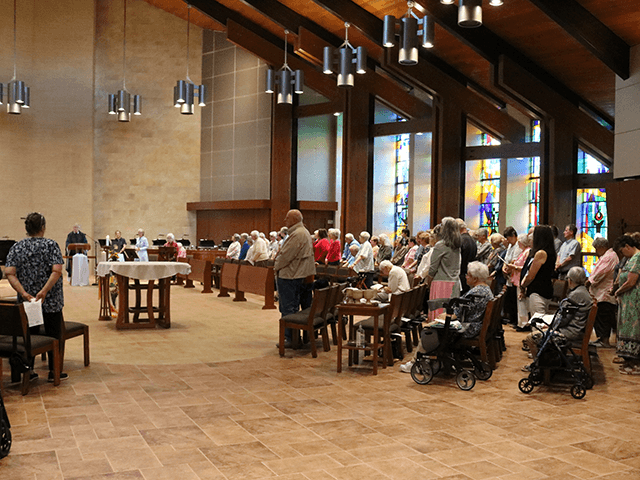
Sisters, oblates, and guests celebrated a special 170th Anniversary Liturgy on June 14. Celebrant Rev. John Beal offered a beautiful reflection on Sunday's Gospel, Matthew 9:36—10:8. His reflections incorporated the Benedictine anniversary; they follow:
"They were troubled and abandoned, like sheep without a shepherd."
That was Jesus' assessment of the crowd that had flocked to him two thousand long ago. Things had not changed much when Benedicta Riepp and her five companions arrived here 170 years ago, and they have not changed much since. "Troubled and abandoned, like sheep without a shepherd," that is still a pretty fair description of us.
We too are troubled—troubled by the slings and arrows of outrageous fortune and the slings and arrows of even more outrageous people, troubled by seas of troubles that threaten to inundate us and our lives like towering tidal waves, troubled by doubts whether what we and those who went before us marked with the sign of faith have built for 170 years here can still survive and thrive. We too feel abandoned—abandoned to grope alone through the encircling gloom for a glimmer of hope, abandoned to wander alone through that spiritual wasteland of the labyrinthine ways of our own minds in search of sustenance for our souls, abandoned to try alone to continue our long, long rowing into God. And we too are like sheep without a shepherd, not because shepherds (and sometimes shepherdesses) do not exist, but because they have so often failed us.
Long ago, Jesus had pity on the crowd of troubled and abandoned people, not by sitting on his hands and mouthing pious laments or by wringing his hands and waiting for shepherds to appear. No, he showed his compassion by sending out a motley crew of disciples to these lost sheep and proclaim, "The reign of God is at hand." Those first twelve were not a particularly distinguished group. They were not rabbis well trained in the Law or candidates for tenure track positions at leading universities; they were not particularly talented or holy. They were so very flawed and so very human, but they had been touched by the nearness of God in Jesus, and it had given them strength to struggle with their weaknesses and failings and make progress in overcoming them. They proclaimed only that the reign of God was near, not that it had been established in all its fulness already. They were willing to share how the love of God at work in Jesus had given them the courage to confront their own demons and keep them at bay. They were willing to live lives that showed how trust in the power greater than themselves had enabled them to grapple with their disappointments and doubts, their fears and frustrations and find a peace that surpasses all understanding. And because these twelve were willing to share their experience of Jesus, the strength and hope they had found in him, those to whom they were sent were able take heart as well. As a result, sick bodies and sick souls were cured, shattered lives and broken hearts were made whole, demons were driven out. They would be surprised that their efforts led to a church that has lasted to this day. And, I suppose, Benedicta and her companions would be surprised at all this.
What about us, the troubled and abandoned of today? We are as frail, as flawed, as foible-filled as that first band of bozos Jesus sent out. He did not ask them to install a working version of the reign of God on earth, and he does not expect us to do so. What was once asked of them and now is asked of us is to evoke in our words and embody in our lives a reason to hope for the day when they truly will beat swords into ploughshares and spears into pruning hooks and plan for war no more, reason to believe in a time when dashed dreams and dead hopes can live again, a reason to hope for an hour when migrants and other lepers are welcomed, a time when the poor really do hear good news. That day did not arrive in Jesus' lifetime or that of his first twelve. It did not happen in the lifetime of Benedicta and her five companions, and it will not happen in ours. What there will be here in another 2000 years or even in another 170 years do not know. It is in God's hands, not ours. We have only to keep the hope alive today.
As Edna Saint Vincent Millay wrote:
My candle burns at both ends; it will not last the night.
But, ah, my foes, and oh, my friends, it gives such lovely light.
