


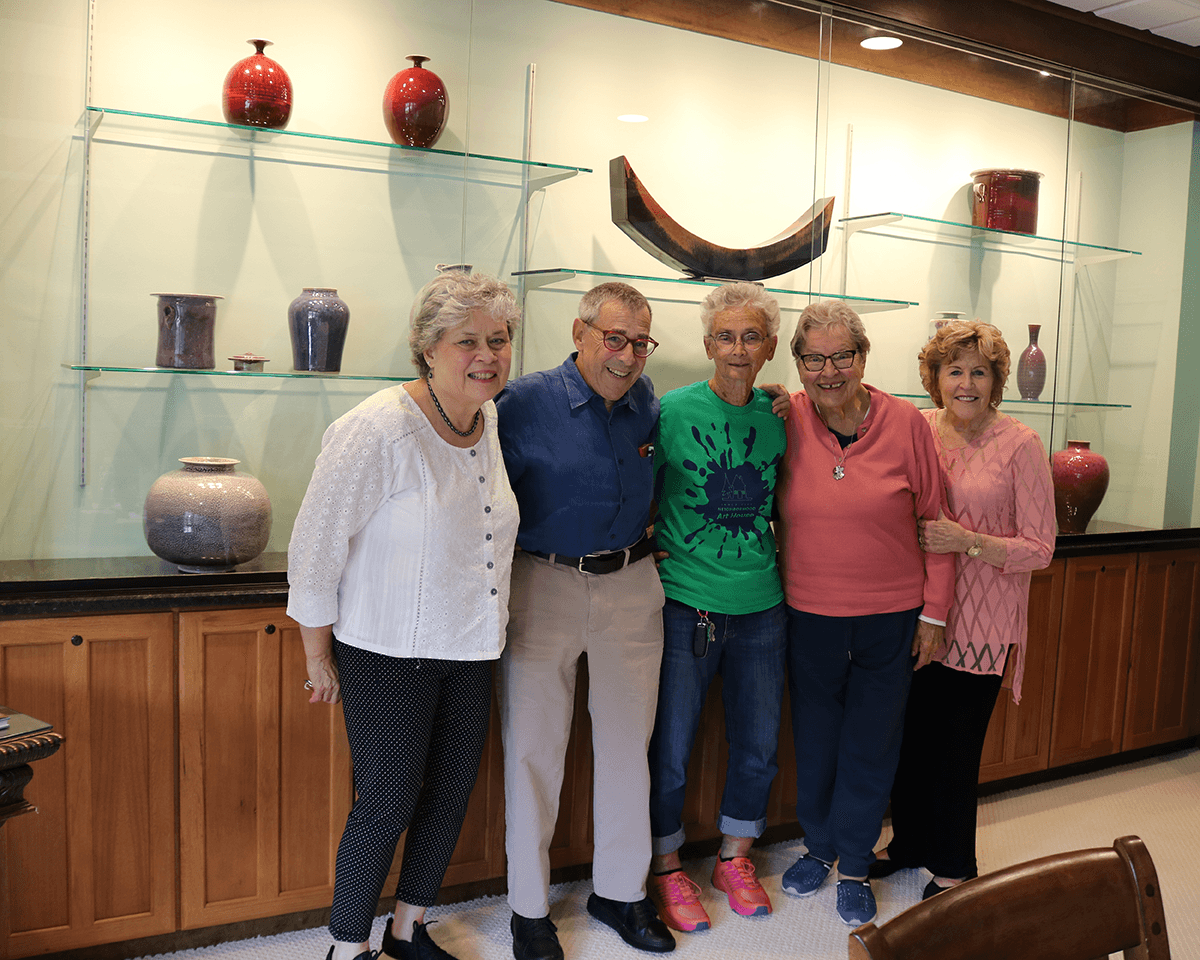
“Safe to say, if not for the concepts of welcome the stranger and speak to the stranger, I would not be sitting here,” David Bloom, a recent visitor to the monastery told a handful of friends of world-renowned potter, Brother Thomas Bezanson. The group had gathered to remember Brother Thomas and share stories with David, whose family knew Thomas well. It was David’s first time in Erie.
Brother Thomas, who died in 2007, was artist-in-residence at Mount St. Benedict Monastery in Erie for twenty-two years. A former monk at Weston Priory in Vermont, he moved to Erie to take up residence with the Benedictine community in 1984 at the invitation of then-prioress Sister Joan Chittister. While Brother Thomas’s work is displayed in museums around the world, he regularly gifted the Erie community with his pots. When he died, their collection included more than a hundred pieces. In addition to learning more about Brother Thomas from people who knew him well during the last third of his life, David also wanted to see the sisters’ collection of his work.
David’s Erie connection was made about ten years ago at a concert at Cathedral of John the Divine in his home city of New York—when he welcomed the stranger sitting next to him and spoke with her. Turns out the stranger was Mary Ellen Dahlkemper who was in New York with her husband. When she began, “We’re from Erie, Pennsylvania…” David had to ask, “is there any chance you’ve ever heard of Brother Thomas Bezanson…” Mary Ellen, a friend of the Benedictine community, said yes.
A couple months ago David was elected to the board of the US Committee for Refugees and Immigrants. He wanted to visit a local office and noticed there was an active and engaged office in Erie. And he thought, “That nice couple I met from Erie…I wonder…”
He hadn’t kept in touch with Mary Ellen, but thanks to technology, her contact was still in his phone. They connected and she shared her work in Erie that is related to welcoming the stranger and immigrants in Erie. “We’re a great community,” she told him. “And the Benedictines have been long involved in this work.”
Mary Ellen brought David to the monastery where Sisters Carolyn Gorny-Kopkowski, Pat Lupo, and Linda Romey and dear friend Sandra Bock were gathered in the front parlor where the main display of Thomas’s work is located.
David first shared his story, how his parents came across Thomas’s work in a shop in Vermont and were directed to the priory to meet him. They became friends and eventually introduced Thomas to Bernie and Sue Pucker whose Pucker Gallery in Boston eventually became home to Thomas's work.
“You saved his life,” David told the sisters. “It’s not clear that he would have been a great artist if it weren’t for the Benedictine Sisters.” When he left Weston Priory, he wasn’t able to create art. It took some time, remembered Sister Carolyn, who with another sister shared a home with Thomas. But then one day he called out to her with a little more energy. “I did it! I made a pot,” was what he wanted to tell her. That was after a year of not doing anything, of making excuses. After that, the creativity never stopped.
“He worked solo, but he needed us all for different reasons,” remembered Sandy. “I think he found joy in a lot of things but being that brilliant and that gifted, maybe it’s difficult to be really happy.” She explained that he set high standards for himself which maybe made happiness more elusive—but also helped him be accepting of others. “He was a truly fascinating, and very intense, human being,” she said.
Yet he was also very down-to-earth. “He always wore jeans and sweatshirts, when the children at camp saw him going in back door, they thought he was the janitor,” said Carolyn. They lived on the grounds of the community’s summer camp. “He was just Thomas. He was our brother.”
Sandy remembers running into Thomas at the end of a firing. “I’m opening the kiln,” he told her. “Would you like to come?” As she looked into the large kiln her breath was taken away by the shelves filled with the beauty of glazes and shapes and she couldn’t speak.”I was so overwhelmed by the beauty,” she said. In reply, Thomas said, “Sometimes there are no words.”
